Words, phrases, clauses, and sentences constitute what is called the GRAMMATICAL HIERARCHY. We can represent this schematically as follows:
sentences consist of one or more...
clauses consist of one or more...
phrases consist of one or more...
words
Sentences are at the top of the hierarchy, so they are the largest unit which we will be considering (though some grammars do look beyond the sentence). At the other end of the hierarchy, words are at the lowest level, though again, some grammars go below the word to consider morphology, the study of how words are constructed.
At the clause level and at the phrase level, two points should be noted:
1. Although clauses are higher than phrases in the hierarchy, clauses can occur within phrases, as we've already seen:
The man who lives beside us is ill
Here we have a relative clause who lives beside us within the NP the man who lives beside us.
2. We've also seen that clauses can occur within clauses, and phrases can occur within phrases.
Bearing these two points in mind, we can now illustrate the grammatical hierarchy using the following sentence:
My brother won the lottery
This is a simple sentence (S), consisting of a matrix clause (MC):
We can subdivide the clause into an NP and a VP:
The VP contains a further NP within it:
So we have a total of three phrases. Each phrase consists of individual words:
Each of the bracketed units here is a word, a phrase, or a clause. We refer to these as CONSTITUENTS. A constituent is defined as a word or a group of words which acts syntactically as a unit. |
| As a means of illustrating the grammatical hierarchy, the labelled brackets we have used here have at least one major drawback. You've probably noticed it already -- they are very difficult to interpret. And the problem becomes more acute as the sentence becomes more complex. For this reason, linguists prefer to employ a more visual method, the TREE DIAGRAM. |
A tree diagram is a visual representation of syntactic structure, in which the grammatical hierarchy is graphically displayed. Here's the tree diagram for our sentence, My brother won the lottery:
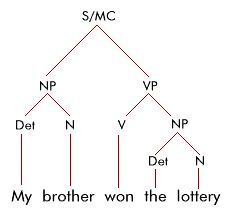
A tree diagram contains exactly the same information as its corresponding labelled bracketing, but it is much easier to interpret.
No comments:
Post a Comment